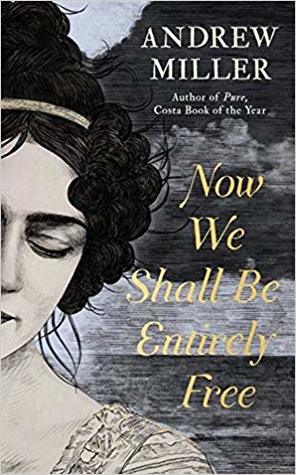

A very reliable friend recommended this, and then I saw it won the Walter Scott Prize for Historical fiction. I have also read and enjoyed Now we Shall be Entirely Free. I have a library copy, but I have ordered a copy from Boundless Books (trying to keep an independent book shop in business).
Here’s the blurb ..
December 1962, a small village near Bristol.
Eric and Irene and Bill and Rita. Two young couples living next to each other, the first in a beautiful cottage – suitable for a newly appointed local doctor – the second in a rundown, perennially under-heated farm. Despite their apparent differences, the two women (both pregnant) strike an easy friendship – a connection that comes as a respite from the surprising tediousness of married life, with its unfulfilled expectations, growing resentments and the ghosts of a recent past.
But as one of the coldest winters on record grips England in a never-ending frost and as the country is enveloped in a thick, soft, unmoving layer of snow, the two couples find themselves cut off from the rest of the world. And without the small distractions of everyday existence, suddenly old tensions and shocking new discoveries threaten to change the course of their lives forever.
This novel had a very interesting structure because the people we meet in the first chapter aren’t the people the rest of the novel focusses on. This novel is more about character than plot. We follow two married couples – Eric and Irene, and Bill and Rita. Both couples are recently married and now are expecting babies. There are class differences, the shadows of World War Two (Martin has been shattered by what he saw while liberating Belsen), and an extremely cold winter that brings the country to a grinding halt (quite literally – the trains and buses stop running). It is beautifully written, with a lot of period detail (there was a lot of drinking, smoking and drug taking even Irene and Rita), and domestic minutiae. It’s about people trying to live in a world recovering from devastation, evil and despair. There is mental illness, infidelity, kindness, sadness and resignation.
I need to think about this more, and possibly re-read it. I got caught up in the story and rushed through, without paying proper attention.
Some of my favourite quotes
[…] in the corridor there were lino tiles, geometries in bright colours. You had to be careful not to get lost on it, not try stepping only from green square to green square, or find yourself marooned on a red triangle.
Time would level it out, for that, he had learned (quite recently) was what time did.
When he heard her coming up the stairs he’d pushed it [photo album] back into the shadows under the bed and thought hos nice it was, what a relief, to be free of the past.
Is it possible to be free of the past?
And though he was not much given to thinking about love, did not much care for the word, thought it has been worn to a kind of uselessness, gutted by the advertising men and the crooners, and even by politicians, some of whom seemed, recently, to have discovered it, it struck him that in the end, it might just mean a willingness to imagine another’s life. To do that. To make the effort.
He was like a bird whose arrival heralded better weather.
This is wrote Andrew Miller wrote about it.