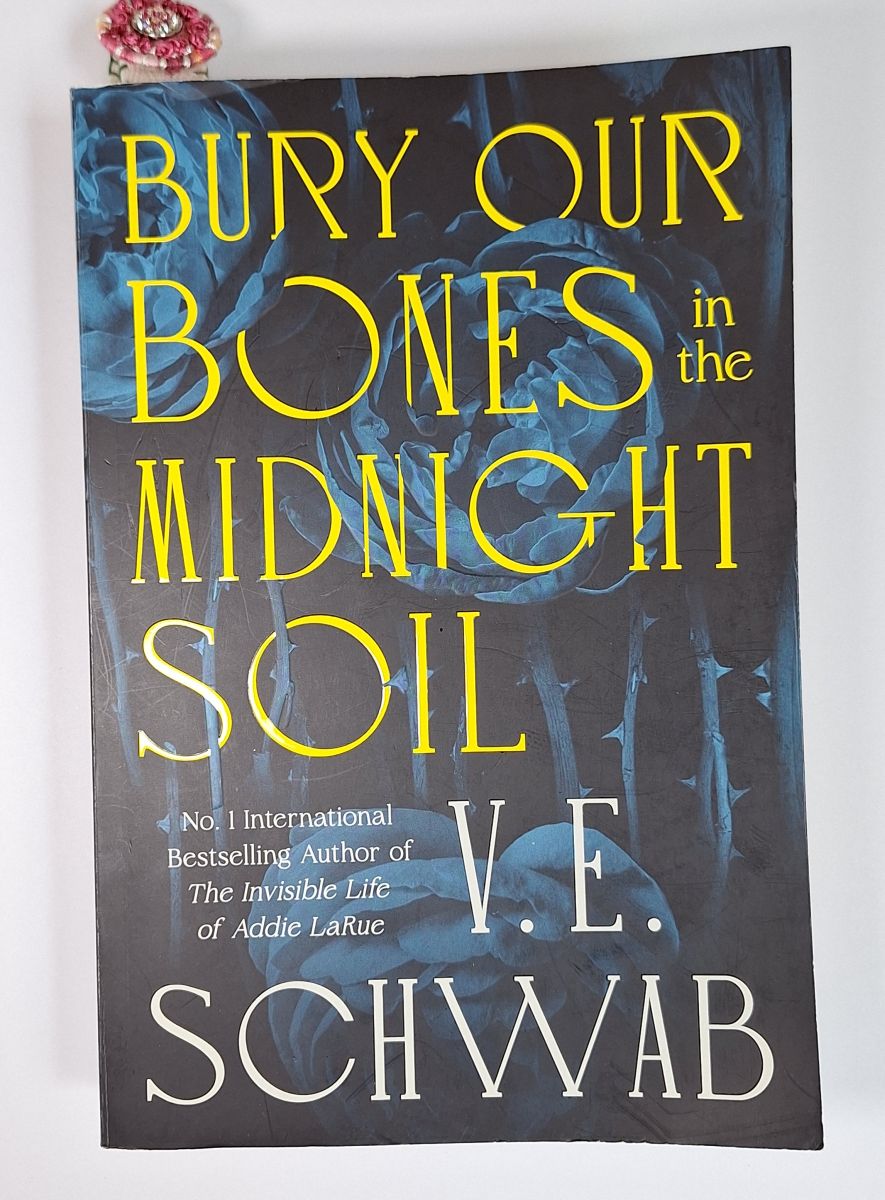
Bury our Bones in the Midnight Soil – V. E. Schwab
I am a fan of V. E. Schwab. I have listened to The Invisible Life of Addie La Rue and Gallant. So when I saw this on sale at Target, I had to have it. Of course, it then lingered on my shelves (although I think I purchased it this year).
Here’s the blurb …
This is a story about hunger. 1532. Santo Domingo de la Calzada. A young girl grows up wild and wily—her beauty is only outmatched by her dreams of escape. But María knows she can only ever be a prize, or a pawn, in the games played by men. When an alluring stranger offers an alternate path, María makes a desperate choice. She vows to have no regrets.
This is a story about love. 1827. London. A young woman lives an idyllic but cloistered life on her family’s estate, until a moment of forbidden intimacy sees her shipped off to London. Charlotte’s tender heart and seemingly impossible wishes are swept away by an invitation from a beautiful widow—but the price of freedom is higher than she could have imagined.
This is a story about rage. 2019. Boston. College was supposed to be her chance to be someone new. That’s why Alice moved halfway across the world, leaving her old life behind. But after an out-of-character one-night stand leaves her questioning her past, her present, and her future, Alice throws herself into the hunt for answers . . . and revenge.
This is a story about life— how it ends, and how it starts.
I do enjoy the historical fiction aspects of this novel. I didn’t know at all what it was about and I was quite surprised when I discovered what ‘bury our bones in the midnight soil’ means. Although this is a fantasy novel, it’s really about people – relationships, family, chosen family, friendships and toxic relationships. It’s about women claiming space and agency for themselves.
It was long and I am not sure it needed to be that long. We could have had a few less incidents in Sabine’s life without losing any of the character or plot development.
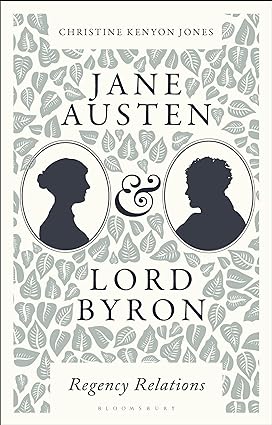
Jane Austen and Lord Byron – Christine Kenyon Jones
I bought this in London while browsing various book stores (we did a bit of a book tour of London).
Here’s the blurb …
Jane Austen and Lord Byron are often presented as opposites, but here they are together at last. In Regency England he was the first celebrity author while she was a parson’s daughter writing anonymously. This book explores how their lives, interests, work and sense of humour often brought them within touching distance, and sets them side by side in the world of the Regency and Romantic period.
Using some little-known sources and new research, it illustrates how they were distantly related by marriage; how they knew about each other even though they probably never met; the acquaintances they had in common and how their literary work often came close in subject-matter, approach, technique and tone.
Engagingly written and beautifully illustrated, this book will inform and delight scholars and Austen and Byron fans alike, showing that these two great authors were closer than you might think, even in their own day.
I am not convinced. Given the size of the population at the time and, in particular, the number of people in the gentry, there will be similarities and connections.
However, there were a lot of interesting points. For example, Byron and Austen were distantly related. They had the same publisher (John Murray) and shared some of the same concerns ‘a rogue, but a civil one’. They both enjoyed the theatre and possibly saw the same performances – or at least the same play.
I read Audition on my Boox and when I finished it I couldn’t be bothered getting up and finding a paper book, so I looked for what else I had on my Boox, and this one was the first thing I saw.
Here’s the blurb …
Laid off from her department store job, Carmen has perilously little cash and few options. The prospect of spending Christmas with her perfect sister Sofia, in Sofia’s perfect house with her perfect children and her perfectly ordered yuppie life does not appeal.
Frankly, Sofia doesn’t exactly want her prickly sister Carmen there either. But Sofia has yet another baby on the way, a mother desperate to see her daughters get along, and a client who needs help revitalizing his shabby old bookshop. So Carmen moves in and takes the job.
Thrown rather suddenly into the inner workings of Mr. McCredie’s ancient bookshop on the picturesque streets of historic Edinburgh, Carmen is intrigued despite herself. The store is dusty and disorganized but undeniably charming. Can she breathe some new life into it in time for Christmas shopping? What will happen when a famous and charismatic author takes a sudden interest in the bookshop–and Carmen? And will the Christmas spirit be enough to help heal her fractured family?
This was lovely. I particularly enjoyed all of the Edinburgh references – I want to visit that bookshop. This was a cozy romance. No terrible people, a bit of character growth, and some witty dialogue and situations.
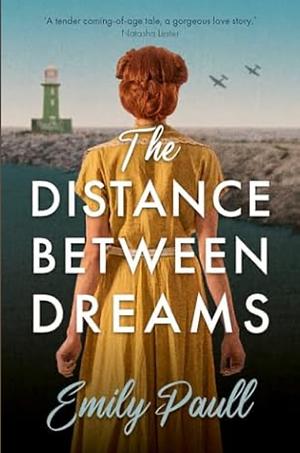
My local library (Evelyn H Parker) was having an Author talk and craft event. Ms Paull was one of the authors. So, in preparation, I read this novel.
I do like a novel set in W.A.
Here’s the blurb …
Sarah Willis longs to free herself from the expectations of a privileged upbringing, while Winston Keller can’ t afford the luxury of a dream. Despite their differences, the pair are drawn together in a whirlwind romance that defies the boundaries of class. But when a dark family secret pulls the young lovers apart, and WWII plunges the world into chaos, it seems impossible they will ever find their way back to each other &– or even hold onto the dream of what might have been
It is clear that a lot of research went into this novel. I learnt quite a few things. For example, I didn’t know that there was rationing (here in W.A) during World War Two. Or that there were so many war brides (not to mention the ones who got duped).
The characters are well-written, particularly the bitchy Florence. Winston and his mother, Elsie, were delightful. Robert Willis might be a bit too stark a villain, but otherwise this was an interesting and enjoyable novel to read.
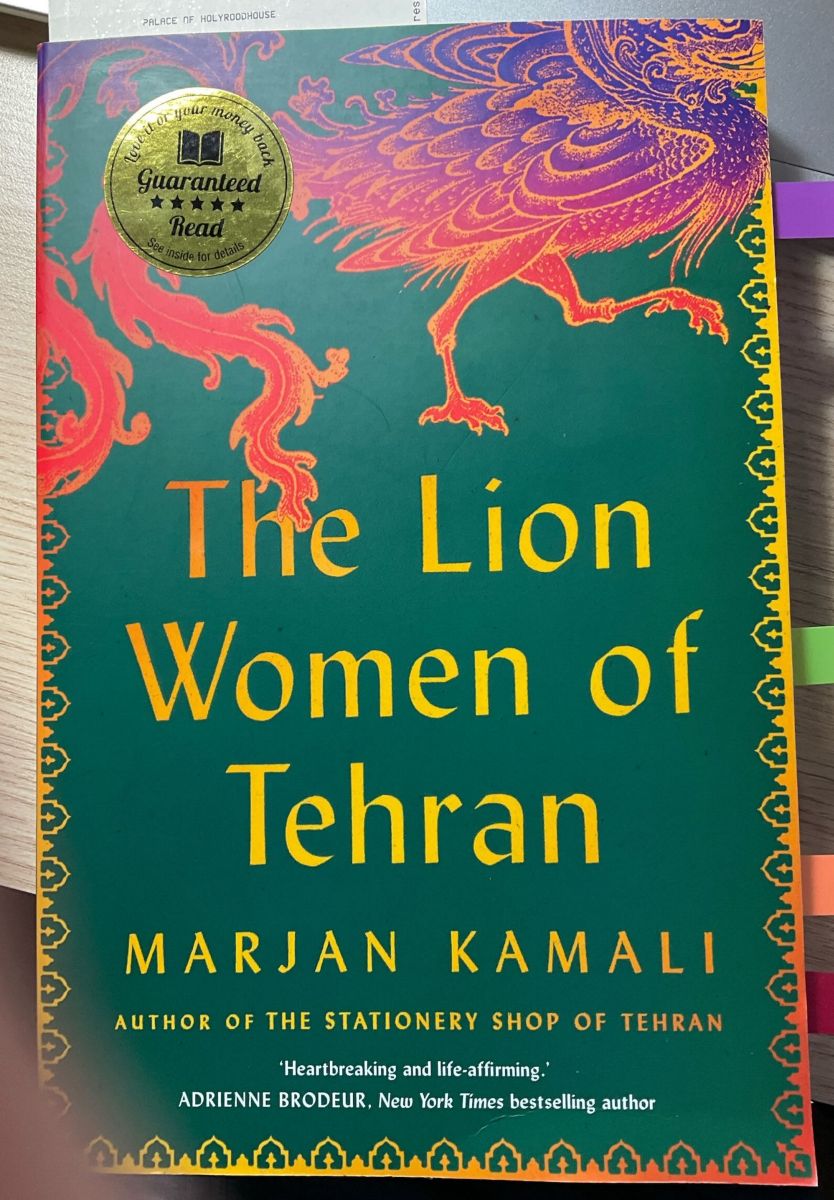
This was the book chosen by my Wednesday (but we meet on a Monday) book club.
Here’s the blurb …
An “evocative read and a powerful portrait of friendship, feminism, and political activism” (People) set against three transformative decades in Tehran, Iran—from nationally bestselling author Marjan Kamali.
In 1950s Tehran, seven-year-old Ellie lives in grand comfort until the untimely death of her father, forcing Ellie and her mother to move to a tiny home downtown. Lonely and bearing the brunt of her mother’s endless grievances, Ellie dreams for a friend to alleviate her isolation.
Luckily, on the first day of school, she meets Homa, a kind girl with a brave and irrepressible spirit. Together, the two girls play games, learn to cook in the stone kitchen of Homa’s warm home, wander through the colorful stalls of the Grand Bazaar, and share their ambitions of becoming “lion women.”
But their happiness is disrupted when Ellie and her mother are afforded the opportunity to return to their previous bourgeois life. Now a popular student at the best girls’ high school in Iran, Ellie’s memories of Homa begin to fade. Years later, however, her sudden reappearance in Ellie’s privileged world alters the course of both of their lives.
Together, the two young women come of age and pursue their own goals for meaningful futures. But as the political turmoil in Iran builds to a breaking point, one earth-shattering betrayal will have enormous consequences.
I have spent a lot of time with this novel. I read each chapter twice and wrote summaries. For me this novel was about friendship, feminism, loyalty, and betrayal. The structure of the novel is very good. Different time periods and different points of view. This creates perspective – you see the same events in a different light. I think it could have been a bit tighter, a few less scenes in every time period. However, it should be widely read to bring the plight of the Iranian people to a bigger audience (and not just see them as part of the ‘axis of evil’). And also to appreciate how the British and Americans interfered in the government of the country to suit their national interests (that’s a problem that has come home to roost).
I know very little about Iran. I enjoyed all of the descriptions of Iranian culture. And how, with the Shah, women had some rights and were encouraged to be educated. It seemed to be quite a secular society. And now, I think they must be some of the most oppressed women in the world. It is very disheartening.
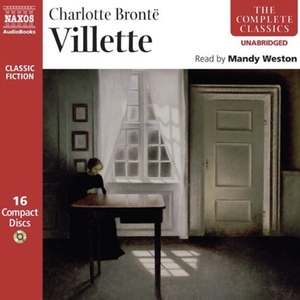
I have tried to read Villette many times. I usually get to the part when Lucy is desperately lonely and visits the catholic church. However, this time I made it all the way to the end (and it has a happy ending (well maybe a happy ending) – who knew? I thought it was going to be miserable).
Here’s the wikipedia summary
Villette begins with its protagonist and unreliable narrator, Lucy Snowe, aged 13, staying at the home of her godmother Mrs. Bretton in “the clean and ancient town of Bretton”, in England. Also in residence are Mrs. Bretton’s teenaged son, John Graham Bretton (whom the family calls Graham), and a young visitor, Paulina Home (who is called Polly), who is aged 6. Polly’s mother, who neglected her daughter, has recently died and her father is recommended by doctors to travel to improve his spirits. Polly is invited by Mrs. Bretton to stay. Polly is a serious little girl, who is described as unlike normal children.
Polly soon develops a deep devotion to Graham, who showers her with attention. But Polly’s visit is cut short when her father arrives to summon her to live with him abroad.
For reasons that are not stated, Lucy leaves Mrs. Bretton’s home a few weeks after Polly’s departure. Some years pass, during which an unspecified family tragedy leaves Lucy without family, home, or means. After some initial hesitation, she is hired as a caregiver by Miss Marchmont, a rheumatic crippled woman. Lucy is soon accustomed to her work and has begun to feel content with her quiet, frugal lifestyle.
The night of a dramatic storm, Miss Marchmont regains all her energy and feels young again. She shares with Lucy her sad love story of 30 years ago, and concludes that she should treat Lucy better and be a better person. She believes that death will reunite her with her dead lover. The next morning, Lucy finds Miss Marchmont died in the night.
Newspaper illustration from abridged version of Villette, 1909
Lucy then leaves the English countryside and goes to London. At the age of 22, she boards a ship for Labassecour despite knowing very little French. On the ship, she meets Ginevra Fanshawe, who tells Lucy that the directress of her boarding school for girls (based upon the Hegers’ Brussels pensionnat) she is attending, Madame Beck, needs a bonne for her children. She travels to the city of Villette in Labassecour where Madame Beck’s school is located. After a time, she is hired to teach English at the school, in addition to having to mind Madame Beck’s three children. She thrives despite Madame Beck’s constant spying on the staff and students.
“Dr. John,” a handsome English doctor, frequently visits the school at the behest of Madame Beck, and deepens his affection for the coquette Ginevra Fanshawe. In one of Villette’s famous plot twists, “Dr. John” is later revealed to be John Graham Bretton, a fact that Lucy has known since he once asked her why she was staring at him, but has deliberately concealed from the reader.
During the school holidays, all the teachers and pupils have either gone to travel abroad or gone back to their families. The school is completely empty except for a disabled child whom Lucy is supposed to take care of. After the disabled child is fetched away, Lucy is extremely lonely and becomes both mentally and physically ill. She goes to a Catholic church (despite being a Protestant) to confess to a priest. On the way back to the school, she collapses due to fever and mental exhaustion. Dr. John brings her to his home, which he shares with his mother, Mrs. Bretton.
Graham recognises Lucy only after she is brought to Mrs. Bretton’s home. After Dr. John (i.e., Graham) discovers Ginevra’s true character while at the theatre, he turns his attention to Lucy, and they become close friends. She values this friendship highly despite her usual emotional reserve. Lucy soon develops feelings for Dr. John and treasures the letters he sends her once she returns to the pensionnat.
Lucy and Graham meet Polly (Paulina Home) again at the same theatre after a fire, in which Polly is injured. Polly’s father has inherited the title “de Bassompierre” and is now a Count; thus her name is now Paulina Mary Home de Bassompierre. Polly and Graham soon discover that they knew each other in the past and slowly renew their friendship. They fall in love and eventually marry despite the initial reluctance of Polly’s father.
Lucy becomes progressively closer to a colleague, the irascible, autocratic, and confrontational professeur, M. Paul Emanuel, a relative of Mme. Beck. Lucy gradually realises that his apparent antagonism is actually helping her to overcome her weaknesses and to grow. She and Paul eventually fall in love.
However, a group of conspiring antagonists, including Madame Beck, the priest Père Silas, and the relatives of M. Paul’s long-dead fiancée, work to keep the two apart, on the grounds that a union between a Catholic and a Protestant is impossible. They finally succeed in forcing M. Paul’s departure for Guadeloupe to oversee a plantation there. He nonetheless declares his love for Lucy before his departure and arranges for her to live independently as the headmistress of her own day school, which she later expands into a pensionnat.
During the course of the novel, Lucy has three encounters with the figure of a nun — which may be the ghost of a nun who was buried alive on the school’s grounds as punishment for breaking her vow of chastity. In a highly symbolic scene near the end of the novel, she discovers the “nun’s” habit in her bed and destroys it. She later finds out that it was a disguise worn by Ginevra’s amour, Alfred de Hamal, placed in Lucy’s bed as a prank. The episodes with the nun no doubt contributed substantially to the novel’s reputation as a gothic novel. Ginevra keeps in contact with Lucy through letters that show the young coquette has not changed and expects to live off of her uncle’s (Basompierre’s) good graces.
Villette’s final pages are ambiguous. Although Lucy says that she wants to leave the reader free to imagine a happy ending, she hints strongly that M. Paul’s ship was destroyed by a storm during his return journey from the West Indies. She says that, “M. Emanuel was away three years. Reader, they were the three happiest years of my life.” This passage suggests that he was drowned by the “destroying angel of tempest.”
There is not much of a plot to this novel, it’s more about Lucy’s progress through life. Her loneliness, her self-possession, the impact other people have on her (both well-meaning and not so well-meaning – Madame Beck and her surveillance). The story is told from Lucy’s point of view. She is a solitary creature who longs for human connection. It is definitely from the 19th century, there is a lot of thinking, religion, and discussions about duty.
After my success at listening to War and Peace, I decided to try Anna Karenina, and this version is read by Maggie Gyllenhaal (what could be better?).
Here is the Goodreads blurb …
Acclaimed by many as the world’s greatest novel, Anna Karenina provides a vast panorama of contemporary life in Russia and of humanity in general. In it Tolstoy uses his intense imaginative insight to create some of the most memorable characters in all of literature. Anna is a sophisticated woman who abandons her empty existence as the wife of Karenin and turns to Count Vronsky to fulfil her passionate nature – with tragic consequences. Levin is a reflection of Tolstoy himself, often expressing the author’s own views and convictions.
Throughout, Tolstoy points no moral, merely inviting us not to judge but to watch. As Rosemary Edmonds comments, ‘He leaves the shifting patterns of the kaleidoscope to bring home the meaning of the brooding words following the title, ‘Vengeance is mine, and I will repay.
I am sure that everyone knows the story of Anna Karenina. And I have watched several adaptations; this one – with Keira Knightley, this one – with Sophie Marceau and Sean Bean as Vronsky, and a modern Australian version, The Beautiful Lie – with Sarah Snook.
Given that I felt I knew the story, I was pleasantly surprised by the novel. I have always thought that Karenin and Vronsky dashing and heroic, and Anna makes really bad decisions. However, now I think Karenin was good, but too christian, and Vronsky is a cad, and Anna still makes really bad decisions.
Although to be fair to Anna, this was the time before divorce, and she was stuck in a marriage with an old boring man, and she had nothing to do.
Vronsky should not have pursued her so relentlessly. He was selfish and self-centred.
Anna reminded me of Madame Bovary – that need for drama, romance and love. Not to mention blowing up their own lives. Madame Bovary was serialised in 1856 and Anna Karenina was published in 1878. Was Tolstoy having a conversation with Flaubert? Or is this a common type of woman in the 19th Century?
I did, however, like Levin and Kitty. They made up for all of the awful, selfish characters.
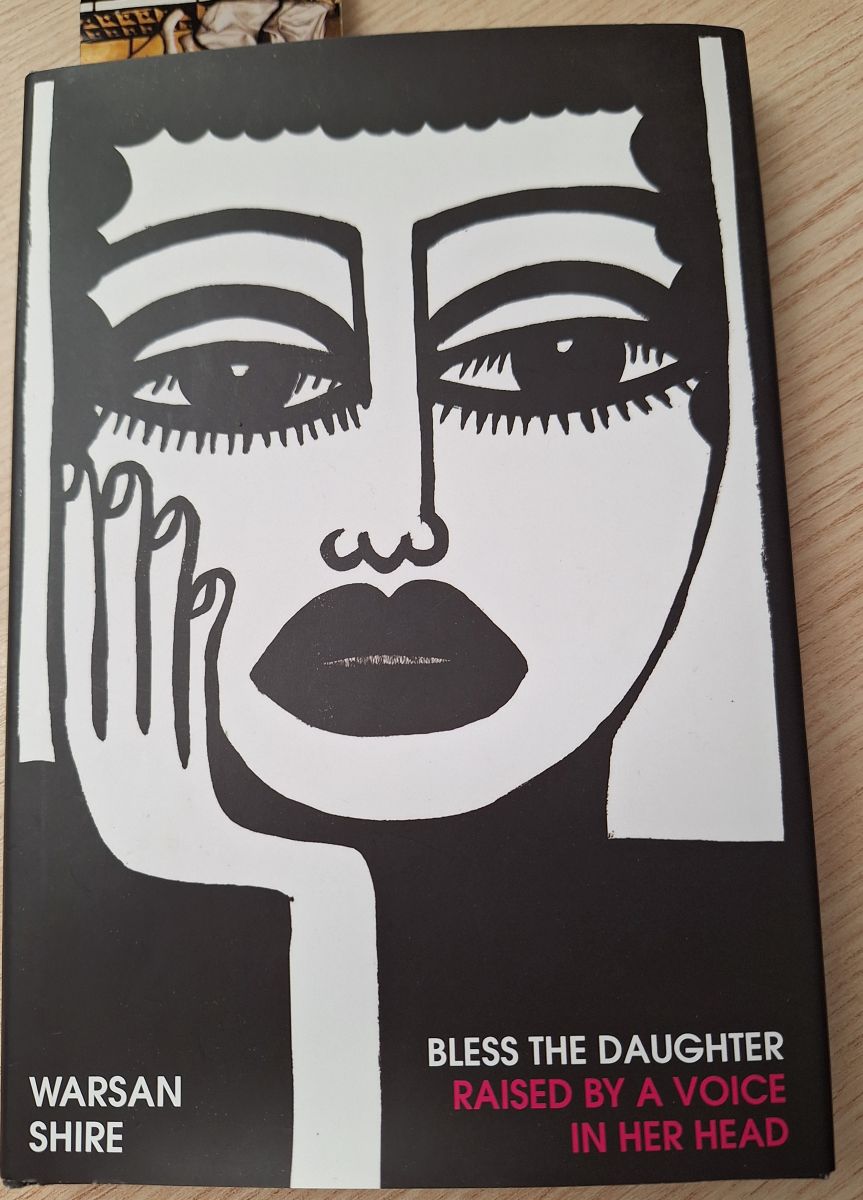
Bless the Daughter Raised by a Voice in her Head – Warsan Shire
I won this book and I wasn’t sure if I would like it, but I did.
Here’s the description
Poems of migration, womanhood, trauma, and resilience from the celebrated collaborator on Beyoncé’s Lemonade and Black Is King, award-winning Somali British poet Warsan Shire.
Mama, I made it out of your home, alive, raised by the voices in my head.
With her first full-length poetry collection, Warsan Shire introduces us to a young girl, who, in the absence of a nurturing guide, makes her own stumbling way towards womanhood. Drawing from her own life and the lives of loved ones, as well as pop culture and news headlines, Shire finds vivid, unique details in the experiences of refugees and immigrants, mothers and daughters, Black women, and teenage girls. In Shire’s hands, lives spring into fullness. This is noisy life: full of music and weeping and surahs and sirens and birds. This is fragrant life: full of blood and perfume and shisha smoke and jasmine and incense. This is polychrome life: full of henna and moonlight and lipstick and turmeric and kohl.
The long-awaited collection from one of our most exciting contemporary poets, this book is a blessing, an incantatory celebration of resilience and survival. Each reader will come away changed.
These poems are about the immigrant and refugee experience. Gender violence, child abuse, but also the strength gained through female friendships. The poems are beautiful and moving, and very meaningful but also frustrating (why are these terrible things still happening?)
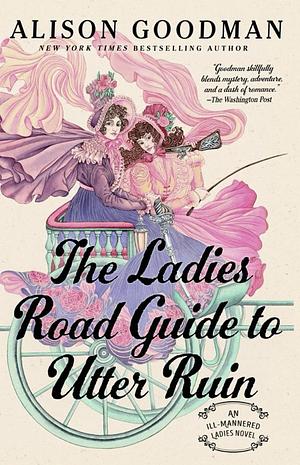
Miss A got this from Dymocks as an advanced reader copy. It languished on my pile until a friend read it, and then I finally dug it out. I have read the first one, and I think it is better if you read the first one before this one.
Here’s the blurb …
To most of Regency high society, forty-two-year-old Lady Augusta Colebrook, or Gus, and her twin sister, Julia, are just unmarried ladies of a certain age—hardly worth a second glance. But the Colebrook twins are far from useless old maids. They are secretly protecting women and children ignored by society and the law.
When Lord Evan—a charming escaped convict who has won Gus’s heart—needs to hide his sister and her lover from their vindictive brother, Gus and Julia take the two women into their home. They know what it is like to have a powerful and overbearing brother. But Lord Evan’s complicated past puts them all in danger. Gus knows they must clear his name of murder if he is to survive the thieftakers who hunt him. But it is no easy task—the fatal duel was twenty years ago and a key witness is nowhere to be found.
In a deadly cat-and-mouse game, Gus, Julia, and Lord Evan must dodge their pursuers and investigate Lord Evan’s past. They will be thrust into the ugly underworld of Georgian gentlemen’s clubs, spies, and ruthless bounty hunters, not to mention the everyday threat of narrow-minded brothers. Will the truth be found in time, or will the dangerous secrets from the past destroy family bonds and rip new love and lives apart?
These novels are adventurous romps. They’re full of period detail, but the heroines and heroes have modern sensibilities (at least as to how they view women). The villains are despicable and evil, and then there are the men (and women) who have extremely conservative views (Lord Duffy for instance).
There is an occasional reference to Austen – one of the characters is reading Sense and Sensibility and another character is given the false name of Miss Dashwood.
He glared at me. “I do not take my leave of you, Augusta. You will not receive my courtesy until you behave in the manner of a gentle woman and a sister.”
Very Lady Catherine De Burgh.
These are lots of fun and the end sets up the next one.
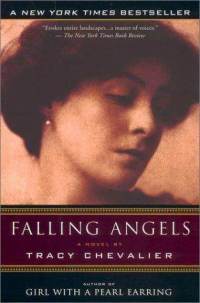
The theme for my book club is ‘Democracy’. I thought of the suffragettes and this was suggested (by google) as a book about suffragettes – is it though?
Here’s the blurb …
In her New York Times bestselling follow-up, Tracy Chevalier once again paints a distant age with a rich and provocative palette of characters. Told through a variety of shifting perspectives- wives and husbands, friends and lovers, masters and their servants, and a gravedigger’s son-Falling Angels follows the fortunes of two families in the emerging years of the twentieth century.
I am a fan of Tracy Chevalier’s novels. My favourites being The Lady and the Unicorn, and A Single Thread (neither of which I have blogged about).
This has all of the hallmarks of a Chevalier novel – well-researched, beautifully written, and focussing on women. It’s about two privileged families at the turn of the century navigating the societal and cultural changes. It’s about women and how little control they had over their bodies, money, and time. Some women no longer want to be ‘the angel in the home’.

.jpg)