Category Archives: Fiction

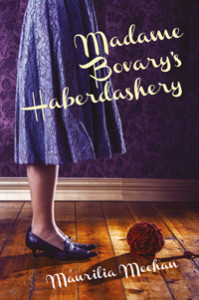
Madame Bovary’s Haberdashery – Maurilia Meehan

Madame Bovary's Haberdashery

Madame Bovary’s Haberdashery – Maurilia Meehan

Who could resist a title like that? I found this in a second hand book store in Albany and couldn’t resist.

Here is the blurb …

Zac, a translator of Flaubert, can’t believe his luck. He ends up sleeping with Odette, a beautiful but capricious ceramic artist, and her best friend, Cicely, a talented knitter and author of an erotic novel. As well as an interest in Madame Bovary the three share a brief ménage à trois. That is, until things unravel in unexpected ways, Cicely adopts the logical detection methods of a Miss Marple, and we come to know the delightful Miss Ball and her haberdashery.

In a plot that plays with the conventions of the mystery, and delightfully subverts one of its treasured finales, this delicious novel is not afraid to be literary and fun and sexy all at once. Award-winning novelist Maurilia Meehan deftly pays homage to both Christie and Flaubert, while also creating a true original: the first in a series of delightful page-turners for lovers of noir, passion and great literature.

It was the perfect holiday read – easy to read, a bit exciting and there was knitting.

More reviews …

https://www.australianbookreview.com.au/about/98-april-2013-no-350/1438-maurilia-meehan-madame-bovary-s-haberdashery

http://www.smh.com.au/entertainment/books/madame-bovarys-haberdashery-20130510-2jcyd.html


Leave a Comment

Filed under Fiction

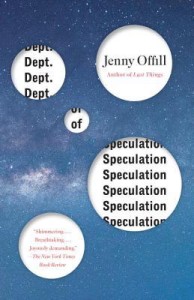
Dept of Speculation – Jenny Offill

Dept. of Speculation - Jenny Offill

Dept. of Speculation – Jenny Offill

This was recommended by a friend who happens to be a great writer, so I was keen to read it.

Here is the blurb …

Dept. of Speculation is a portrait of a marriage. It is also a beguiling rumination on the mysteries of intimacy, trust, faith, knowledge, and the condition of universal shipwreck that unites us all.

Jenny Offill’s heroine, referred to in these pages as simply “the wife,” once exchanged love letters with her husband postmarked Dept. of Speculation, their code name for all the uncertainty that inheres in life and in the strangely fluid confines of a long relationship. As they confront an array of common catastrophes—a colicky baby, a faltering marriage, stalled ambitions—the wife analyzes her predicament, invoking everything from Keats and Kafka to the thought experiments of the Stoics to the lessons of doomed Russian cosmonauts. She muses on the consuming, capacious experience of maternal love, and the near total destruction of the self that ensues from it as she confronts the friction between domestic life and the seductions and demands of art.

With cool precision, in language that shimmers with rage and wit and fierce longing, Jenny Offill has crafted an exquisitely suspenseful love story that has the velocity of a train hurtling through the night at top speed. Exceptionally lean and compact,Dept. of Speculation is a novel to be devoured in a single sitting, though its bracing emotional insights and piercing meditations on despair and love will linger long after the last page.

The style of this novel is what really sets it apart – it is a series of paragraphs that seem unconnected and yet somehow convey a story. It also moves around in time (what I mean is that the story is not told linearly) and sometimes it’s first person and sometimes third. It is worth reading more than once – I enjoyed my first reading, but loved my second.

More reviews …

http://www.smh.com.au/entertainment/books/review-dept-of-speculation-by-jenny-offill-20140722-zt3yy.html

http://www.theguardian.com/books/2014/mar/14/dept-speculation-review-jenny-offill

Leave a Comment

Filed under Fiction, Recommended

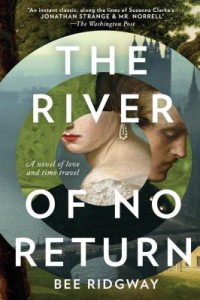
The River of No Return – Bee Ridgway

The River of No Return - Bee Ridgeway

The River of No Return – Bee Ridgeway

This was one of my book club books that was highly recommended by one of the members. I had never heard of it and it proved to be quite difficult to find a paper copy. In the end I found one at the library and read it quickly to pass onto someone else in the group.

Here is the blurb …

Two hundred years after he was about to die on a Napoleonic battlefield, Lord Nicholas Falcott wakes up in twenty-first-century London. The Guild, a secretive fraternity of time travelers, informs him that there is no return. But Nick yearns for the beautiful Julia Percy, who remains in 1815. As fate and the fraying fabric of time draw Nick and Julia together once again, the lovers must match wits and gamble their hearts against the rules of time itself.

Rich in romance and historical detail, Bee Ridgway’s debut is a thrilling, fast-paced narrative evocative of Deborah Harkness’s time-bending bestsellers.

I found it very compelling and enjoyed the detail of the various time periods. It was long and could have been edited to make a snappier story. It also had that annoying plot device where one character doesn’t communicate a significant plot point to another and the story continues for another (unnecessary) two hundred pages – an exaggeration, but you know what I mean. It always reminds me of day time soap operas.

I hope there is a sequel in the works because the story didn’t seem finished to me – it would make a great movie too.

More reviews …

https://www.washingtonpost.com/entertainment/books/bee-ridgways-the-river-of-no-return/2013/05/03/73c1a286-adce-11e2-a986-eec837b1888b_story.html

http://www.express.co.uk/entertainment/books/403931/Book-Review-The-River-Of-No-Return


Leave a Comment

Filed under Fiction

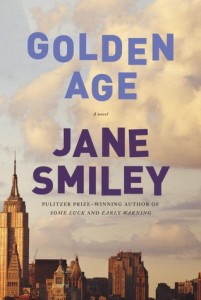
Golden Age – Jane Smiley

Golden Age - Jane Smiley

Golden Age – Jane Smiley

I read this straight after Early Warningso that I would have all of the characters and plot lines straight in my head. I struggled a bit with the gap between Some Luck and Early Warning.

Here is the blurb …

A lot can happen in one hundred years, as Jane Smiley shows to dazzling effect in her Last Hundred Years trilogy. But as Golden Age, its final installment, opens in 1987, the next generation of Langdons face economic, social, political—and personal—challenges unlike anything their ancestors have encountered before.

Michael and Richie, the rivalrous twin sons of World War II hero Frank, work in the high-stakes world of government and finance in Washington and New York, but they soon realize that one’s fiercest enemies can be closest to home; Charlie, the charming, recently found scion, struggles with whether he wishes to make a mark on the world; and Guthrie, once poised to take over the Langdons’ Iowa farm, is instead deployed to Iraq, leaving the land—ever the heart of this compelling saga—in the capable hands of his younger sister.

Determined to evade disaster, for the planet and her family, Felicity worries that the farm’s once-bountiful soil may be permanently imperiled, by more than the extremes of climate change. And as they enter deeper into the twenty-first century, all the Langdon women—wives, mothers, daughters—find themselves charged with carrying their storied past into an uncertain future.

Combining intimate drama, emotional suspense, and a full command of history, Golden Age brings to a magnificent conclusion the century-spanning portrait of this unforgettable family—and the dynamic times in which they’ve loved, lived, and died: a crowning literary achievement from a beloved master of American storytelling.

As you can see from the blurb, this continues the story (saga) of the Langdon family. Some bits of this I really enjoyed – Andy recovering from her alcohol addiction getting her own back on Michael and his dodgy financial practices, but found the extrapolation into the future unsettling (that might have been the point) and Guthrie’s fate was very upsetting. Once again, it is beautifully written in simple prose. It reminds me a bit of Forrest Gump in that the Langdon family just happen to be around for significant historical events, but these novels cover a huge range of history and how the events affected different segments of society.

More reviews …

http://www.theguardian.com/books/2015/oct/21/golden-age-jane-smiley-review-final-volume-the-last-hundred-years-trilogy

https://www.washingtonpost.com/entertainment/books/golden-age-review-jane-smiley-brings-america-into-the-age-of-terror/2015/10/12/b64bba0e-701f-11e5-8d93-0af317ed58c9_story.html

Leave a Comment

Filed under Fiction

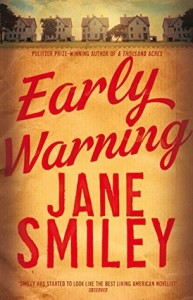
Early Warning – Jane Smiley

Early Warning - Jane Smiley

Early Warning – Jane Smiley

This is the second novel is Jane Smiley’s trilogy The Last One Hundred Years – it started with Some LuckI enjoyed reading Some Luck but took my time getting this second volume (I did move straight onto the third though – Golden Age – but more of that later).

Here is the blurb …

From the Pulitzer Prize winner: a journey through mid-century America, as lived by the extraordinary Langdon family we first met in Some Luck, a national best seller published to rave reviews from coast to coast.

Early Warning opens in 1953 with the Langdons at a crossroads. Their stalwart patriarch Walter, who with his wife had sustained their Iowa farm for three decades, has suddenly died, leaving their five children looking to the future. Only one will remain to work the land, while the others scatter to Washington, DC, California, and everywhere in between. As the country moves out of postwar optimism through the Cold War, the social and sexual revolutions of the 1960s and ’70s, and then into the unprecedented wealth—for some—of the early ’80s, the Langdon children will have children of their own: twin boys who are best friends and vicious rivals; a girl whose rebellious spirit takes her to the notorious Peoples Temple in San Francisco; and a golden boy who drops out of college to fight in Vietnam—leaving behind a secret legacy that will send shockwaves through the Langdon family into the next generation. Capturing an indelible period in America through the lens of richly drawn characters we come to know and love, Early Warning is an engrossing, beautifully told story of the challenges—and rich rewards—of family and home, even in the most turbulent of times.

Out of the three novels this has been my favourite – I felt I learned a bit of American social history (Peoples Temple, the cold war spy drama, etc) and the characters are so diverse but equally beautifully written. This novel reminds me a bit of Middlemarch in its sprawling nature with a lot of characters and plot lines. This novel is about individual characters, but it also tells the story of a particular country at a particular time.

More reviews …

http://www.theguardian.com/books/2015/apr/30/early-warning-jane-smiley-review-american-tolstoy

http://www.independent.co.uk/arts-entertainment/books/reviews/early-warning-by-jane-smiley-book-review-the-complete-chronicle-of-american-life-10215664.html

https://www.washingtonpost.com/entertainment/books/jane-smileys-elegiac-look-at-an-american-family-in-early-warning/2015/04/27/9f56ab4a-e525-11e4-905f-cc896d379a32_story.html

1 Comment

Filed under Fiction

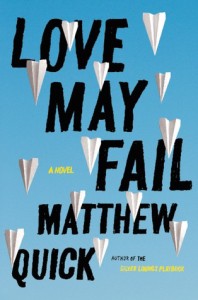
Love May Fail – Matthew Quick

Love May Fail - Matthew Quick

Love May Fail – Matthew Quick

I loved reading The Good Luck of Right Now it was one of my favourite books of 2014 and so I was super-keen to read this one. I even managed to find a copy at the Rottnest General Store.

Here is the blurb …

Portia Kane is having a meltdown. After escaping her ritzy Florida life and her cheating pornographer husband, she finds herself back in South Jersey, a place that remains largely unchanged from the years of her unhappy youth. Lost and alone, looking for the goodness she believes still exists in the world, Portia sets off on a quest to save the one man who always believed in her—and in all of his students: her beloved high school English teacher, Mr. Vernon, who has retired broken and alone after a traumatic classroom incident.

Will a sassy nun, an ex-heroin addict, a metal-head little boy, and her hoarder mother help or hurt Portia’s chances on this quest to resurrect a good man and find renewed hope in the human race? Love May Fail is a story of the great highs and lows of existence: the heartache and daring choices it takes to become the person you know (deep down) you are meant to be.

Mr Quick is one of the only authors I know who writes about mental illness in a funny and generous manner. I didn’t like this one as much as The Good Luck of Right Now, hardly surprising given how much I liked that one. Portia ultimately just seemed whiny. I wanted her to just leave poor Mr Vernon alone. This novel is about being kind and looking after each other, but it didn’t really work for me and I was a bit disappointed.

More reviews …

https://www.bostonglobe.com/arts/books/2015/06/25/love-may-fail-matthew-quick/WzZiEsEewm14CG1z3zMaJP/story.html

http://www.smh.com.au/entertainment/books/love-may-fail-review-matthew-quicks-work-is-uneven-but-has-redeeming-features-20150604-ghc8vj.html

Leave a Comment

Filed under Fiction

Summer at Mount Hope – Rosalie Ham

Summer at Mount Hope - Rosalie Ham

Summer at Mount Hope – Rosalie Ham

I read this a few years ago and wasn’t that taken with it – in fact I gave my copy away. However, recently a friend talked about how much she liked it, so I thought I would give it another go – it did mean buying another copy!

Second time around I have to say I really liked it. I think I was put off it the first time by it being described as an ‘outback Pride and Prejudice‘ because I have to say it is nothing like Pride and Prejudice unless it is in the annoying younger sister way or the not being romantic and settling way (you know Charlotte Lucas and Mr Collins).

Here is the blurb …

Summer At Mount Hope is the story of a young woman growing up in rural Victoria, Australia in a time of drought and depression. It is the story of her quest to retain freedom despite the strictures and expectations of family and society.

I’m starting to wonder about Ms Ham because all of her stories are a bit bleak – hilariously funny at times, but bleak none the less. Think about the ending to The Dressmaker – definitely successful revenge, but not what you would call a happy ending.

In this one Phoebe Crupp is living on her parents’ vineyard looking forward to running it herself one day. Times are tough and her sister is desperate to make a good marriage – preferably with the son of the local big land owner. Times are tough and it turns out that the Overton’s (local landowners) have sold a part of their land to Mr Steel (who is acting as the manager). Phoebe falls in lust/love with Mr Steel, but he is not free to marry her. Meanwhile Lilith, Phoebe’s sister, entraps Marius Overton into marriage. Everything goes pear-shaped, the Overtons lose their property and there is nothing for it but for Marius and Lilith to take over the vineyard. Phoebe is devastated she feels that her father has sold her out. She settles for Hadley (a neighbour who has always loved her) and moves away.

This novel is about constraints on women and their inability to control the direction of their lives – a good marriage is the only path to security and even that can go awry (look at Lilith). Phoebe sensible, practical and hard-working is not allowed to run the vineyard.  There is an epilogue which implies that Phoebe returns triumphant and takes over, but we, the reader, don’t get to read about it.

Another review

http://www.smh.com.au/news/book-reviews/summer-at-mount-hope/2005/12/13/1134236049529.html

Leave a Comment

Filed under Fiction

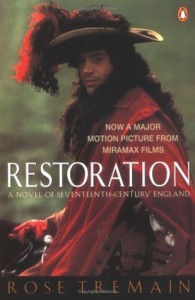
Restoration – Rose Tremain

Restoration - Rose Tremain

Restoration – Rose Tremain

I have a list of books that I have read and mean to blog about, but it is getting quite long and I don’t take notes while reading, so by the time I get to a particular book on the list all I have is a vague memory of the novel and whether I liked it or not.

Here’s the Wikipedia plot summary for this one …

The novel tells the story of Robert Merivel, a 17th-century English physician. After supervising the recovery of one of the dogs of King Charles II, he is appointed surgeon to all of the king’s dogs. He then joins in all of the debauchery of King Charles’ court. The king then arranges a marriage of convenience between Merivel and one of his mistresses, Celia Clemence. This is done purely to fool the king’s other mistress Barbara Castlemaine. Merivel is given an estate named Bidnold in Norfolk, and Celia is installed in a house in Kew, where the king can visit her secretly.

In Norfolk, Merivel abandons the practice of medicine, and lives a dissipated life in which he tries to take up painting with the help of an ambitious painter named Elias Finn. Things start to change when Celia is sent to Bidnold by the king after displeasing him. One night Merivel drunkenly makes advances to her, and is promptly reported to the king by Elias Finn. The result is that the king confiscates the Bidnold estate from Merivel.

Merivel then joins his old student friend John Pearce at the New Bedlam hospital, also in Norfolk. (New Bedlam is fictitious and should not be confused with the real Bedlam in London.) This is a hospital for the mentally ill, run by Quakers, of whom Pearce is a member. In earlier parts of the novel, Pearce has condemned the sinfulness of Merivel’s lifestyle, and Merivel now joins the hospital with the best of intentions, and hoping to rediscover his medical vocation. However, things go wrong when he has an affair with a patient named Katharine and makes her pregnant. This coincides with the death of Pearce. He is expelled from the hospital, and travels with Katharine to be with her mother in London.

In London, which is then experiencing the Great Plague, Merivel continues practising medicine. Katharine has a baby girl, but dies in childbirth. During the Great Fire of London in 1666, Merivel rescues an elderly woman from a burning house. It is this which regains him the king’s favour, and at the end the king allows him to live at Bidnold with his daughter.

The title of the novel refers both to the Restoration period during which it occurs, and to the novel’s ending when Merivel returns to Bidnold and the king’s favour.

This novel is a rollicking ride of debauchery, finery, sadness and redemption. Merivel cannot stop himself destroying his own advantages – at heart he is a good person, but he is lazy and greedy (for everything food, money the king’s attention). I enjoyed it immensly  and when I get to the end of my enormous pile of to be read books I shall read Merievel: A Man of his Time.

The BBC World Book Club has an interview with Rose Tremain, which is definitely worth listening to and here are more reviews …

http://www.theguardian.com/books/2012/oct/05/book-club-restoration-rose-tremain

http://www.nytimes.com/1990/04/15/books/a-yuppie-in-king-charles-s-court.html
1 Comment

Filed under Fiction

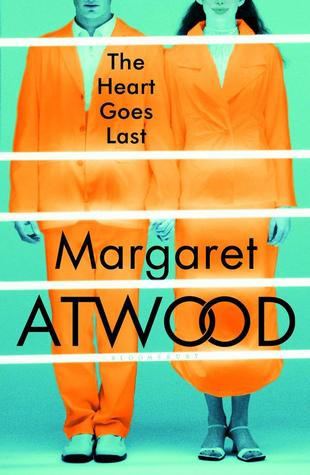
The Heart Goes Last – Margaret Atwood

The Heart Goes Last - Margaret Atwood

The Heart Goes Last – Margaret Atwood

I do like Atwood novels. Clearly I had to read this one as soon as possible – I think I even pre-ordered it.

Here’s the blurb …

Living in their car, surviving on tips, Charmaine and Stan are in a desperate state. So, when they see an advertisement for Consilience, a ‘social experiment’ offering stable jobs and a home of their own, they sign up immediately. All they have to do in return for suburban paradise is give up their freedom every second month – swapping their home for a prison cell. At first, all is well. But then, unknown to each other, Stan and Charmaine develop passionate obsessions with their ‘Alternates,’ the couple that occupy their house when they are in prison. Soon the pressures of conformity, mistrust, guilt and sexual desire begin to take over.

This novel had an intriguing premise – people live normal lives for a month and then are imprisoned for a month. They have ‘alternates’ with whom they share a house – when you are in prison your alternate is in the house and vice-versa. In this way a community only needs half as many houses and jobs. The community is extremely isolated – once you are in you can’t leave, there is no internet access and the only media available is produced by Consilience. As you no doubt imagine, sinister things are afoot. What has happened to the original (and true criminals)? What exactly does Charmaine do in her prison time (I will give you a clue the title has something to do with her job)? There are affairs, sex dolls, headless chickens and mind control through brain surgery. Atwood paints a dreary picture of the future and what big business will do to us all – and then we hear about the antics of VW and realise big business probably is amoral.

More reviews …

http://www.nytimes.com/2015/09/30/books/review-margaret-atwoods-the-heart-goes-last-conjures-a-kinky-dystopia.html?_r=0

http://www.theguardian.com/books/2015/sep/07/the-heart-goes-last-review-margaret-atwood-stan-charmaine-positron-project-consilience-prison


Leave a Comment

Filed under Fiction

Defending Jacob – William Landay

Defending Jacob - William Landay

Defending Jacob – William Landay

This one was selected for me by my book club – it came right after Apple Tree Yard, so I was a bit concerned I might be ‘crimed’ out, but not so I found it a compelling page turner.

Here’s the blurb …

Andy Barber has been an assistant district attorney in his suburban Massachusetts county for more than twenty years. He is respected in his community, tenacious in the courtroom, and happy at home with his wife, Laurie, and son, Jacob. But when a shocking crime shatters their New England town, Andy is blindsided by what happens next: His fourteen-year-old son is charged with the murder of a fellow student.
Every parental instinct Andy has rallies to protect his boy. Jacob insists that he is innocent, and Andy believes him. Andy must. He’s his father. But as damning facts and shocking revelations surface, as a marriage threatens to crumble and the trial intensifies, as the crisis reveals how little a father knows about his son, Andy will face a trial of his own–between loyalty and justice, between truth and allegation, between a past he’s tried to bury and a future he cannot conceive.

This novel reminded me of We need to talk about Kevin – the mother was suspicious and the father oblivious (although maybe he was just in denial). The story is from Andy’s point of view and he is not a reliable narrator – information is revealed at the trial which show Andy’s actions to be more calculating than he is prepared to admit – disposing of the knife he finds in Jacob’s room, suggesting Jacob should rinse his bathers, etc. There is also a debate about nature versus nurture – is there a murder gene? And what responsibility to society and the community does the family of violent people have? Information is revealed to us slowly through the initial investigation, visits to the Pyschiatrist, and the trials (yes there is more than one trial). I was gripped – how could Andy not know? But what happens at the end was completely unexpected.

More reviews …

http://www.nytimes.com/2012/02/13/books/defending-jacob-by-william-landay.html?_r=0

https://www.washingtonpost.com/entertainment/books/defending-jacob-by-william-landay/2012/01/30/gIQAC7AVsQ_story.html

Leave a Comment

Filed under Fiction, Recommended